sobota, 23 września 2017

Ai! yúquëan loar anduinenen undu-siriër
(Tolkien, Rotterdam 1958)

J.R.R. Tolkien, Rotterdam 1958 (cała historia tutaj), wiersz:
«Dwadzieścia lat odpłynęło w dół długiej rzeki
I nigdy za mojego życia nie wrócą one do mnie z morza.
Ach, lata w których, patrząc w dal widziałem wieki dawno minione,
gdy wciąż drzewa swobodnie zakwitały w przestronnej krainie.
Niestety teraz wszystko zaczyna blednąć razem z tchnieniem
czarodziejów o zimnych sercach.
[Żeby poznać rzeczy, niszczą je,
a swe surowe rządy ustanowili
szerząc lęk przed śmiercią.]»
«Twenty years have flowed away down the long river
And never in my life will return for me from the sea.
Ah, years in which, looking far away, I saw ages long past
When still trees bloomed free in a wide country.
Alas, for now all begins to wither in the breath
of cold-hearted wizards.
[To know things they break them
And their stern lordship they establish
Through fear of death.]»
W wierszu Tolkiena bardzo podoba nam się opis świata mitów, do którego wejrzenie ma (mito)poeta:
“wieki dawno minione,
gdy wciąż drzewa swobodnie zakwitały w przestronnej krainie.”
I te tajemnicze słowa o siłach ludzkich, które niszczą nasze życie duchowe, nasz wgląd w głębię rzeczywistości. Mowa tam o “tchnieniu czarodziejów o zimnych sercach” (chyba do nich odnosi się Profesor Tolkien pisząc gdzie indziej o współczesnych “Sarumanach”).

Ludzie ci, podobnie jak Saruman “żeby poznać rzeczy, niszczą (rozłamują) je”. I rządzą ludzkimi duszami (“swe surowe rządy ustanowili”) wykorzystując nasz lęk przed śmiercią (“szerząc lęk przed śmiercią”).

Bardzo to wszystko aktualne i głębokie. A Wy co na ten temat myślicie?

Wiemy, że Profesor wygłosił też ten wiersz w języku quenya. Zachował się zapis audio, który jednak jest zablokowany dla szerszej publiczności przez Tolkien Estate (burarum!). Dawno temu lista dyskusyjna Lambengolmor ogłosiła konkurs na jak najbardziej adekwatne tłumaczenie słów Tolkiena na quenya. Istniała perspektywa rychłej publikacji quenejskiego tekstu samego Tolkiena, ale została zatrzymana (burarururururum!). Chciałbym wam pokazać moją próbę zmierzenia się z tym tekstem. Oto treść mojego wpisu na liście dyskusyjnej Lambenglomor:
I present here my own submission. I have tried to imitate the "Galadriel's Lament" style and I wanted to use as many words from the LotR-times as possible (my main source of the vocabulary was "Parma Eldalamberon" #17).
Ai! yúquëan loar anduinenen undu-siriër
ar ullúmë cuilenyassë entuluva nin ëarello.
Ai! loar yassen palantirala cennen yéni-andë vanwë
írë ambë i aldar lehta-lostaner yanda-noriessë.
Ai! sí ilya queluva súlinen
ringa-hondë istarion.
The only truly coined word is here ullúmë 'never'.

I would love to see Tolkien's Quenya text. I hope it will happen soon. I am open to your comments and questions.
Mam nadzieję, że pewnego dnia poznamy tekst samego Tolkiena... Estelyan.
piątek, 22 września 2017

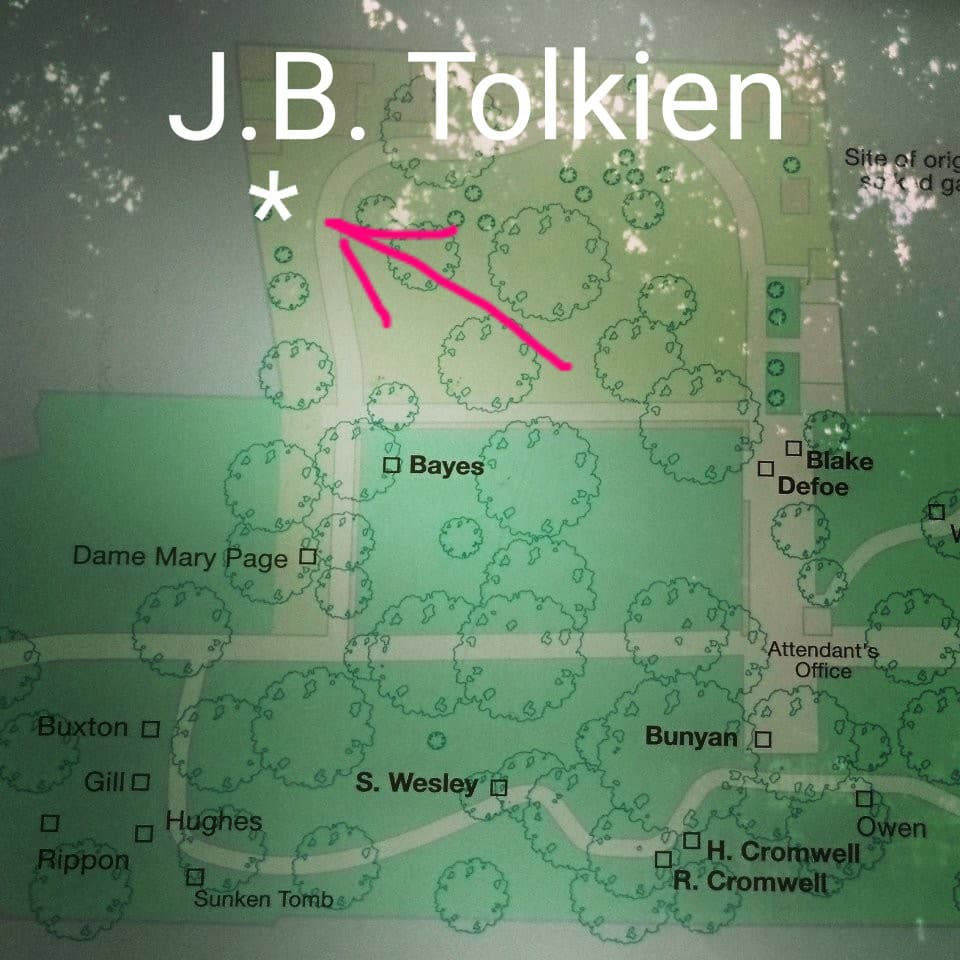
John Benjamin Tolkien's grave in London

More about John Benjamin Tolkien can be found here.

During my last visit to London I was also to the Non-Conformist cemetery of Bunhill Fields (with graves of Defoe, Blake and Bunyan) in front of the Wesley Chapel (where Daniel Tolkien was buried). I found John Benjamin Tolkien's grave where also his wife Mary is buried.

Tolkien (who was born as Johann Benjamin Tolkien in Gdańsk in 1752) is buried in the part of the cemetery which needs renovation in my humble opinion. I worry that this important tomb stone is now in danger being isolated. I hope the London members of our Tolkien Society will help this tomb to survive next few hundreds years!

I still do not know to which Non-Conformist community John and Mary Tolkien belonged. They are buried in the part of the cemetery where we can find members of the Bible Society. The Tolkiens are buried in the same grave as William Shrubsole (see here) who was dismissed from his service in the Anglican Church "for frequenting 'conventicles'". Did the Tolkiens frequented conventicles too? Or were they Lutherans (like their relatives in Gdańsk and East Prussia)? Were they simply Methodists like Daniel and his family? Or maybe they belonged to the evangelical Religious Tracks Society? Or they were connected with the Moravian Brothers? Or maybe they were Baptists? All we know is that they baptized their children in the Savoy Lutheran Church and that they were connected with the Anglican parished in London.

I present my photos from Bunhill Fields Burial Grounds taken in September 2017:


Tolkien and Birmingham Oratory: my visit

More about Tolkien and the Birmingham Oratory see here.

Report from your Tolkienite "Indiana Jones"... Last July I visited Birmingham during a Catholic pilgrimage (I was a guide of this lovely group from a Silesian parish – our goal was Scotland and Northern England). We were welcomed to celebrate our two Holy Masses in the Birmingham Oratory where our host was its Parish Priest, Father Anton Guziel (whose family came to England from our Silesia!). Father Anton was so kind to show us the Oratory Library with its Tolkien souvenirs from the time when Mabel Tolkien and her sons were members of the parish community by the Oratory. Let us see my photographs. Your comments are welcome!

Birmingham Oratory, a sanctuary of the Roman Catholic tradition. Here young Ronald Tolkien served as altar boy
Young Tolkien's primary school by the Oratory
Plates with the names of late Father of the Birmingham Oratory
According to Father Anthon, Father Francis Morgan was Tolkien's inspiration of... Gandalf!
Father Anton said that the Fathers of Oratory live like the Hobbits in their small "holes".
Father said that it is quite possible that these corridors were Tolkien's inspiration of the Hobbit homes
The Oratory Library. See the desk and a trunk under it...
Mabel Tolkien's trunk!

... and happy Galadhorn
Mabel Tolkien's unknown to me photo!
“Exor.” means ‘executor’. Father Francis was executor of Mabel Tolkien’s estate. That booklet contains Father Francis’ accounts of settling her financial legacy

As above - accounts kept in £-s-d
Mabel's book of prayer

First pages of Mabel's book of prayer

Christmas blessings from Father Francis Morgan!
J.R.R. Tolkien's book of Shakespeare's Julius Caesar

Daniel Tolkien's family grave by Wesley's Chapel, London

In his last will he wrote:
I desire that my body may be buried devoutly with as little expence as may be in my family grave in the burial ground of the [...] Chapel of City Road.
Daniel Gottlieb Tolkien born in Gdańsk in July 1746 died (of cancer?) on 26 May 1813 in his 67 year in his residence at Hoxton Square, London. His grave is situated on the back of the Wesley's Chapel at City Road, London (burial number 2574, undertaker: Murrell Skinner, St.Sepulchre). I have found its location thanks to the material published by Mr Ross Milbourne (Register of burials at Wesley's Chapel, book by George J. Stevenson on the historical, biographical and memorial aspects of Wesley's Chapel in London published in 1872, and plan of City Road Chapel and Graveyard from 1890).

Daniel Tolkien's grave and the grave of his family had few inscriptions (tombstone texts):
M. S. Henry, the son of Daniel and Ann [Tolkein sic.] Tolkien, died 14th November 1791, aged 5 months.
Also, Catherine Austen, grandmother of the above, died 21st April 1802, aged 68 years. An affectionate wife and sincere friend.

Also, Mr John Austen, husband of the above, died May 11, 1809, in his 63rd year.

Also, Mr Daniel [Tolkein sic] Tolkien, who departed this life May 26th, 1813, in his 67th year
J. Wesley's tomb
According to the data by Ross Milbourne Daniel Tolkien's family grave can be localized as follows (Tolkien's grave in the red area, John Wesley's grave the yellow circle):

Daniel Tolkien's grave does not exist any more. I show the area where it could be placed

My thanks to Ross Milbourne and his sister, Ruth, for their hard work and advice

czwartek, 21 września 2017

Tolkienowie w Londynie w latach 70. XVIII w.
Krąg bliskich osób

Zadanie dla mnie na czas jesiennej szarugi. Dowiedzieć się więcej o kręgu bliskich osób, które towarzyszyły uroczystościom rodzinnym Daniela i Johanna (Johna) Tolkienów w samych początkach ich życia w Londynie, w latach 70 XVIII wieku. Nazwiska tych osób można wynotować z aktów chrztu pierwszych dzieci Daniela i Johanna. Może to ktoś z nich sprowadził Daniela z Amsterdamu w 1770 roku?

Father Thomas Richards from the German Lutheran Chapel at Savoy, London
John Schneider (present during Daniel's wedding in 1782)
Sarah Scenide (?) (present during Daniel's wedding in 1782)
William Warner (during John's wedding in 1777)
Father William Sellon
Gottlieb Gronsdorff
Andreas Meyer
Catharina Aston
George Hemuth and his wife
Daniel Vierrege
Christian and Maria Elisabeth Schreiber
Anna Bäckler
Elisabeth Schwartz
Regina Wolff
Pastor Lampert

Benjamin and Gottlieb together (London, 1778)

Just another document from London where John Benjamin Tolkien and Daniel Gottlieb Tolkien occur together. It's baptism of Benjamin's daughter, Elisabeth. Her godfather is Gottlieb Tolkien! I have just discovered this act.
Ancestry.co.uk

*ond 'stone' in Ivernian and other ancient words

From one of The Letters of J.R.R. Tolkien (p. 419) in which the Professor discusses the origin of the name Gondor:
(...) When about 8 years old I read in a small book (professedly for the young) that nothing of the language of primitive peoples (before the Celts or Germanic invaders) is now known, except perhaps ond = 'stone' (+ one other now forgotten) (...)
Thanks to Carl F. Hostetter and Patrick Wynne and their text  "Stone Towers" (first presented at Mythcon XXIV in 1993 and then published in Vinyar Tengwar #30) we know now that the "small book for the young" was in fact quite a big book for the older entitled Celtic Britain by John Rhys (1904). Mr Rhys was a professor of Celtic in the Oxford University. You can read it here.

J. Rhys, Celtic Britain, pp. 271-272
And I want to present you the scans of the part of the book about ond and fern...

Sollau-Kilgis, czyli dobra Tolków k. Krzyżporka

Alexander Duncker (1860)

Tak w XIX wieku wyglądał pałac w Kilgis koło Krzyżporka. To w tym miejscu najpewniej znajdowała się rezydencja XV-wiecznych Tolków/Tolkienów, np. Jacoba Tolka/Tolkiena, o którym pisałem tutaj. Szukam śladów Sollau i Kilgis w najdawniejszych źródłach...

Tolkienowie z Globuhnen mogą się okazać bałtyckimi Prusami!

W Codex Diplomaticus Warmiensis (patrz tutaj) znajdujemy XIV- i XV-wieczne zapisy, które łączą nazwę podkrzyżporskiej wsi Globuhnen (po polsku byłyby to Głobuny?) z urzędem tłumaczy w kancelariach krzyżackich, z tak zwanymi tolkami (patrz tutaj).


Oto w Pasłęku (niem. Holland) zapisuje się pewne przywileje czterem Prusom o imionach: Monte, Thomas, Glinse i Glabune. Jako tłumacz w czasie transakcji występuje tolk ('tłumacz') Thomas ze wsi Glabonynen czyli z późniejszych Globuhnen. Być może w tym jednym dokumencie znajdujemy zarówno zasadźcę wsi, Glabuna (jego imię oznacza kogoś, kto otacza opieką, przytula: prus. glabāni 'pieszczota', glābtun 'objąć, uścisnąć'), nazwę jego potomków zawartą w nazwie miejscowej – Glabonyn, l.mn. Glabonynen 'potomek Glabuna') i urząd tolka, który był członkiem tego rodu (?).

Kto wie, czy to od Prusa Thomasa, tolka-tłumacza w kancelarii szpitalnika Ulricha Fricke z Pasłęka, nie pochodziła gałąź rodu o przydomku Tolkin z Glabuhnen. Wiemy, że alternatywna teoria wiąże naszych głobuńskich i krzyżporskich Tolkienów z innym tolkiem, Matthiasem Tolk von Markelingerode, rycerzem, którego ojciec przybył zapewne z Harzu w Niemczech, a matka zapewne pochodziła z rodu nobilów pruskich z okolic Kętrzyna... Ciekawe która teoria zwycięży. 

Na XVII-wiecznej mapie Hartknocha widzimy zarówno pruski gród Witige,
na którego miejscu powstał Krzyżpork, jak i Sollau, gdzie w XV w. siedział rycerz Jacob Tolkien

"Dynasta z Krzyżporka", Paweł Skaliger (1534–1574)

Krzyżpork, miasteczko na historycznej Warmii, które niestety po II wojnie światowej znalazło się pod rządami Sowietów, a tym samym zostało totalnie zniszczone... 

Jednym z nielicznych sławnych, którzy związani byli z Krzyżporkiem (miasteczkiem, które w wyniku moich badań spod hasztaga #TolkienAncestry okazało się matecznikiem Tolkienów z linii J.R.R. Tolkiena) był europejski humanista, alchemik i awanturnik, urodzony w Zagrzebiu Paweł Skaliger. Wiemy, że sfałszował swoje pochodzenie i jako „margrabia Verony” przybył w 1561 do Królewca i wkradł się w łaski starego i schorowanego Księcia Prus, Albrechta. Ten podarował Skaligerowi pewien las koło Benkheim, który  zwano odtąd Lasem Skaligera (niem. Skalicher Forst). Z ziemią tą związane były dobra, do których należało miasteczko Krzyżpork. Dlatego też Skaligera nazywano odtąd „Dynastą z Kreuzburga”. 

Ze swojej pozycji ulubieńca księcia Albrechta, wziął udział w spisku, który wyszedł na jaw w 1566. Chodziło o pucz, w interesie księcia meklemburskiego, Johanna Albrechta. Trzej towarzysze Skaligera zostali skazani na śmierć. Paweł Skaliger zdołał uciec. Jego dobra zostały skonfiskowane. Podróżował jeszcze przez jakiś czas i zmarł w Gdańsku w 1574 roku.

Więcej o Skaligerze tutaj.