sobota, 10 marca 2018

Tolkiens' houses in London found (?)


St John Street today and the area where number 145 was located.
Some houses may come from the Regency times. We should check it!


Thanks to my last stay in London (March 2018) I could visit The Museum of London and I went to see Saint John Street. Thanks to the Museum I could buy the Horwood's Plan of London from 1813. Thanks to my walk along Saint John Street I could see places connected with the early Tolkiens in the capital of the UK, connected with J.R.R. Tolkien's ancestors. Thanks to Horwood's Plan of London I realized that today's numbers of Saint John Street differ from the numbers from the beginning of the nineteenth century.

From early documents and address books we know that John Benjamin Tolkien (b. 1752 in Gdańsk/Danzig, d. 1819 in London) lived in an ancient parish Clerkenwell (see map below). His adresses were: White Lion Street (1799) and 145 Saint John Street (1808). We also know that his business "Gravel & Tolkien" (clock- and watchmakers) was at 49 Saint John Street.

A plan of Clerkenwell in London by James Tyrer, 1805
Clerkenwell has historically been associated with radicalism, from the Lollards in the 16th century, the Chartists in the 19th century and communists in the early 20th century. John Benjamin Tolkien ("The Older") belonged to the radical Christian movement called Countess of Huntingdon Connection (see here). There was also a Freemasonic temple there (and I suppose that the Tolkiens were not only Christian non-conformists, but also the Freemasons).

Looking at Horwood's map I realized that today's numeration is different from that of the 1800s. And new hope emerged that the house where J. R. R. Tolkien's grandfather was born still existed. I have found these two localizations (see also the lower map with the non-comformist Spa Fields Chapel where the Tolkiens attended the services and St James Anglican church where they had to baptize children and marry their wives):

Two addresses of John Benjamin Tolkien (1752 Gdańsk – 1819 London)
At 145 Saint John Street his grandson, John Benjamin Tolkien (1807–1896) was born 
Places important to J. B. Tolkien: (1) Spa Fields Chapel, (2) St James Church,
(3) 49 St John Street, (4) 145 St John Street
I wonder which numbers from Horwood's map belonged to which existing house – if one of them (for instance the one on the right signed yellow) was 145 Saint John Street? Maybe you can help me? Maybe you know a book or a website with old and new numeration? It would be great to find the house where three generations of J. R. R. Tolkien's ancestors lived in London. Please, send me your comments and guesses.

For whole Horwood's map see here.

czwartek, 22 lutego 2018

Language of the mediaeval Tolkiens


One of the earliest texts of the earliest Tolkiens! This is Middle High German from Prussia in the 16th century. And the author of this letter was bishop Fabian von Lossainen, a great-great-grandson of Matthias von Markelingerode, a tolk ('negotiator, translator') of the Theutonic Order in Prussia. In spite this line of the Tolks/Tolkiens did not use the family name Tolkyn/Tolkien ('a descendant of Tolk'), we can call Fabian and early Tolkien... Linguistics, linguistics everywhere in the Tolkien Ancestry! 

In the 1990s an American artist and linguist, Patrick Wynne has created this splendid artwork:


»Sihe halpbruder, diss ist scherpffer dann dein zung«. This artwork is entitled: 'Woodcut from a 15th century German edition of "The Silmarillion": Das Silmarillion. Die geschicht von den elbischen staynen silmarilli genant, printed by Peter Wagner, Nuremberg, 1493.' The artwork illustrates the tale from The Silmarillion on pp. 69-70.

Copernicus, a friend of an early Tolkien!

Niklas Koppernigk or Nicolaus Copernicus (1473–1543)

Fabian von Lossainen
(ca. 1470–1523)
J. R. R. Tolkien's ancestors could be the noble Tolks vel Tolkiens from the goods in Tolko (German Tolks) and Tołkiny (German Tolksdorf) in Prussia (today in the Masuria region in Poland), though J. R. R. Tolkien's immediate ancestors were Prussian rich farmers and village mayors in later times. One of these early Tolkiens from the noble class was a famous bishop of Warmia (German Ermland), Fabian von Lossainen (Polish Fabian Luzjański). He was born ca. 1470 being a son of Martin von Lossainen, commandant of the castle and city of Reszel (Warmia/Ermland) and Elżbieta Kościelecka from the Polish nobility. As a child he was taken hostage by the Teutonic Knights in revenge for his father's defense of Reszel. His last name is also listed as von Lossainen, von Lusian, de Lusian, de Lossainen, from Łęźany, and Tetinger de Lossainensis (see the Tolk/Tolkien family tree below).


Fabian "Tolkien" first studied probably in Koenigsberg (Polish Królewiec), Prussia. Later  he studied in Cologne (from 1486), at the University of Bologna (from 1490, doctorate in canon law in 1500) and in Ferrara (in 1491). He was a canon of the cathedral chapter of Warmia/Ermland (1490); in the chapter he was a colleague of Niklas Koppernigk (Nicolaus Copernicus or Mikołaj Kopernik), famous astronomer (with whom he studied in Bologna). Luzjański was also a legal counselor of Bishop Łukasz Watzenrode of Ermland. He was elected bishop of Ermland by its cathedral chapter on 5 April 1512. Shortly after his election, he was ordained a priest. This most famous early Tolkien (or descendant of Matthias Tolk von Markelingerode) died on 30 January 1523 in Lidzbark Warmiński. Buried in the cathedral in Frombork.
 
I have found a letter from bishop Fabian "Tolkien" to Nicolaus Copernicus and his colleague Heinrich Snellenberg (whole collection of Copernicus' letters can be found here). Maybe one of my readers wants to help me to translate this letter from Latin (or German) into English?
 

piątek, 26 stycznia 2018

«Per crucem ad lucem»
David Tolkien Wotherspoon's coat-of-arms

Daniel Gottlieb Tolkien (b. 1746, Gdańsk, d. 1813, London) and his wife Ann, née Austen had ten children. One of their daughters was Maria whose husband was David Wotherspoon. The Wotherspoons were an English family with their coat-of-arms (in fact the Tolkiens were also the family with noble roots but in the 19th century they didn't remember about their coat-of-arms; see here). David Wotherspoon was a furrier like his father-in-low and he continued Daniel Tolkien's business at Cheapside, London. His first son, David Tolkien Wotherspoon was baptized in the Miles Lane Presbyterian chapel (the same religious community which was close to John Benjamin Tolkien, Daniel Gottlieb Tolkien's brother) and as a young man he emmigrated to Canada. About his family you can read below. And you can see his coat-of-arms (source: Armorial families: a directory of gentlemen of coat-armour, compiled and edited by Arthur Charles Fox-Davies, published 1905:


czwartek, 25 stycznia 2018

«We Meet No More» by J. Tolkien (1839)

From The Lady's Book, vol. 14–15, p. 142–143. The author is most probably John Benjamin Tolkien, the Professor's grandfather.
Oh! no, the spell is broken
And joy's sweet hour is o'er
The last sad word is spoken
We meet, we meet no more.
No longer may I cherish
Of love th' illusive dream

For this, a-las! must perish
With hope's expiring beam
Oh! no, the spell is broken
And joy's sweet hour is o'er
The last sad word is spoken
We meet, we meet no more.

No more from slumber waking,
I hail the eveerful dawn;
No more her smiles partaking,
I pace the verdant lawn –
I pace the verdant lawn.
Life's torch once brightly burning,
Fades like the meteor's ray.

Nor shall its light returning,
Illume my dreary way.
Oh! no, the spell is broken
And joy's sweet hour is o'er
The last sad word is spoken
We meet, we meet no more –
We meet, we meet no more.


George Tolkien
Professor's g-grandfather was a London bass singer!

He belonged to the first Tolkien generation in England (his father and his uncle were born in Gdańsk, Poland). His profession was "a professor of music" in London. When he was born on 20 October 1784 in London, his father, John Benjamin Tolkien, was 32 and his mother, Mary, was 38. He married Eliza Lydia Murrell and they had 11 children together. He died on 7 June 1840 at the age of 55, and was buried in London.

I have discovered today that he was a London singer in many performances because he was a member of the Drury Lane Company by the Theatre Royal where many many years later The Lord of the Rings musical was performed (I saw it personally!). And the member of the same company was the musician William Shrubsole who shares the same grave at Bunhill Fields, London with George's parents!


This is probably why his youngest son Alfred became a London performer, a clown Boleno March (see here) and his sons John Benjamin, William Murrell and Henry became composers (see here and here)!

Tolkien in the Theatre Royal, London (1827)


What a coincidence! In the Theatre Royal on Strand, London where many years ago we could see the musical theatre The Lord of the Rings there was a Tolkien singing as a bass! See here.


John Benjamin Tolkien (1807–1896)
A grandfather, a philanthropist, a religious man

"Certainly the story - typical of the kind of tale that middle-class families tell about their origins - gave colour to the presence of Tolkiens in London at the beginning of the nineteenth century, making their living as clock and watch manufacturers and piano-makers. And it was as a piano-maker and music-seller that John Benjamin Tolkien, Arthur’s father, had come to Birmingham and set up business some years later."

H. Carpenter, J.R.R. Tolkien. Biography


John Benjamin Tolkien (1807–1896) was one of eleven children of George Tolkien and Eliza Lydia, née Murrell. When he was born on 27 March 1807, his father, George, was 22 and his mother, Eliza, was 20. He received his names after the grandfather from Gdańsk and London, Johann/John Benjamin Tolkien (1752–1819, see here). He was married three times and had seven sons and eight daughters. He died on 1 August 1896 having lived a long life of 89 years. J. R. R. Tolkien in his letter from 1951 to Florence Tolkien (see here) wrote about his grandfather, John Benjamin Tolkien ("III"):
He was once a wealthy man, but not one of business and a rigidly religious Baptist and would not deal with music halls or theatres. He was a dear old and poor man in the nineties when I knew him.
John B. Tolkien's father was George Tolkien (furrier apprentice, dealer of watch and clock tools, a bass singer and finally a music professor) representing the first generation of the Tolkiens born in the United Kingdom (his father, Johann/John Benjamin came to England from Gdańsk). He died in 1840 and his last address was 25 Bidborough Street, Camden Town, London. George Tolkien was buried at St George the Martyr's cemetery, Queen Square, London.

St James, Clerkenwell, London

John Benjamin was his second child and second son of the Tolkiens (their children were: George William, John Benjamin, Eliza, William Murrell, Mary Ann, Henry, Rosina Susanna, Edward, Ellen Martha, Septimus and Alfred). He was born on 27 March 1807 at St John Street, Middlesex, London, and he was baptized at St James (Anglican), Clerkenwell, London on 29 April 1807. 

From the parish books of St James, Clerkenwell

It is my discovery that John Benjamin's first wife was probably Emma Baker (married in 1832 in All Saints, Southampton). She probably died soon after. He then lived at St Mary Abbot Kensington. In 1835 he married for the second time with Jane Holmwood (1806–1854) (see the term "widower") in St George church, Bloomsbury, London:


From the parish books of St George, Bloomsbury
Children of John Benjamin and Jane were: Jane (1836–1847), Loisa (1840–1900), Emily (1838–1921) and John Benjamin (1845–1883, born in Birmingham after the family moved). In 1841 the family of John Benjamin and Jane lived at "Tannter Place", Marylebone, London. John Benjamin was there described as a turner. 

In 1847 he and his family lived alredy in Birmingham. His new business "Tolkien & Co. Music and Musical Instruments Dealer" at New Street, Birmingham was dissolved (his companions were W. Chappell and Th. P. Chappell) in August 1847:


In 1849 he was described as a music seller and lived already in Birmingham, in the parish of Aston, in Portland Villa. The family had even a "maid of all work", Maria Swinbourne. Then the family moved. In the same year 1849 we meet John Benjamin Tolkien as a professor of music at Bristol Road, Hemlingford, Edgbaston.

John Benjamin's wife, Jane, died in 1854. As a widower and music seller from Handsworth, Birmingham, in the age of 48, John Benjamin married Mary Jane Stowe (1833–1915, daughter of John Sutcliffe Stowe, a commision agent from Grosvenor Place, Birmingham, of predobaptist or independent denomination). The wedding ceremony took place in the parish church of All Saints in Birmingham on 16 February 1856:

From the parish books of All Saints, Birmingham

John Benjamin and Mary Jane Tolkien had eleven children: Arthur Reuel (1857–1896), Mabel (1858–1937), Grace Bindley (1861–1904), Florence Mary (1863–1944), Frank Winslow (1864–1867), Marian Esther (1866–1934), Howard Charles (1866–1867), Wilfrid Henry (1870–1938), Mary Tolkien (1871–1904), Lawrence George Hammond (1873–1941), Leslie (1875).

Before 1871 the family moved to 2 Heathfield Rd, King's Norton, Worcestershire and before 1881 to Alcester Rd, Kings Norton. There they had a house servant, Ann Hough and house maid, Phebe Powel. It is good to know that third wife of John Benjamin Tolkien, Mary Jane was only three years older than his oldest daughter, Emily! In the census of 1881 J. B. Tolkien is described as a "Piano Fort & Prussia Dealer", in 1891 as a "pianoforte tuner".

John Benjamin Tolkien seems to be also the music composer:


According to the books about the nineteenth century composers he cooperated with his brother Henry from London:


In the 1860s John Benjamin Tolkien was a supporter of the United Brethren community (about Moravian Brothers or Herrnhuts or United Brethren you can read here). He was mentioned in the Periodical accounts relating to the missions of the Church of the United Brethren established among the heathen, v. 20 (1851/1853), v. 21 (1853/1856), v. 22. (1856/1858), v. 23 (1858/1861), v. 24 (1861/1863) v. 25 (1863/1866), v. 26 (1866/1868), v. 28 (1871/1873). He probably attended the services at the Brethren Chapel of the congregation of the United Brethren Church in Bristol with his daughter, Miss Emily Tolkien:
 

He was also a known philanthropist in Birmingham:
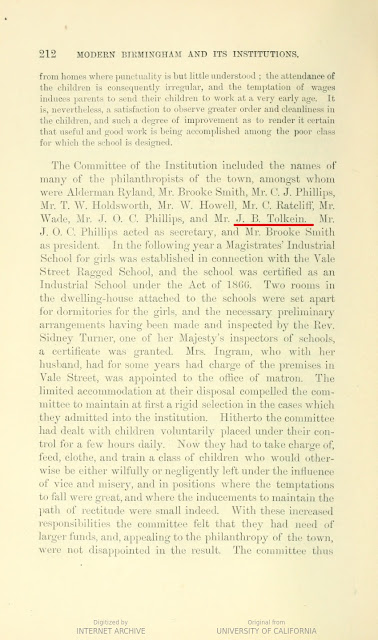
Modern Birmingham and its institutions: a chronicle of local events,
from 1841 to 1871. Comp. and ed. by John Alfred Langford. v. 2, p. 212
John Benjamin Tolkien had his own business in central Birmingham: "J. B. Tolkien – Music Warehouse", 87 New Street, Birmingham (1875, see here). His oldest son was a member of the local Freemason Lodge No. 573 (Lodge of Perseverence in Halesowen, Worcestershire) as a "S.W.", a Senior Warden:

From The Freemason Chronicle (17 April 1875, p. 247)
Another adresses of his business ("Music And Musical Instruments Warehouse") are New Street 70, Birmingham and 2 Haydn Place, Bristol Road, Birmigham. In the same time his younger brother Edward Tolkien was a "Pianoforte tuner" at Clement St, Birmigham.

In 1891 John Benjamin Tolkien lived in his son-in-low's house of Henry Holden's house, his daughter Loisa's husband. His last address was Bell Lane, Erdington, Aston, Warwickshire (close to Birmingham).

After his son Arthur Reuel died in 1896 he also died of sorrow in his age of 89 in King's Norton on 1 August 1896 and was buried at the Key Hill Cemetery, Birmingham. His grave still exists:

Source: FindTheGrave